
Laminate vs. LVP Flooring: Which is Best for Arizona Homes?
If you live in Surprise, Peoria, Goodyear, Buckeye, Avondale, or anywhere else across the West Valley, you have probably already narrowed your flooring search down to two names: laminate flooring and luxury vinyl plank flooring. Almost every homeowner we sit down with ends up at the same fork in the road — which one actually looks better, lasts longer, and survives Arizona?
Both are wood-look, click-together floors that install fast and deliver a real-wood look without the maintenance of real hardwood. But they are not the same product, and one is almost always the smarter choice for any given room. After 25+ years installing flooring in the West Valley, here is the honest, room-by-room, side-by-side comparison.
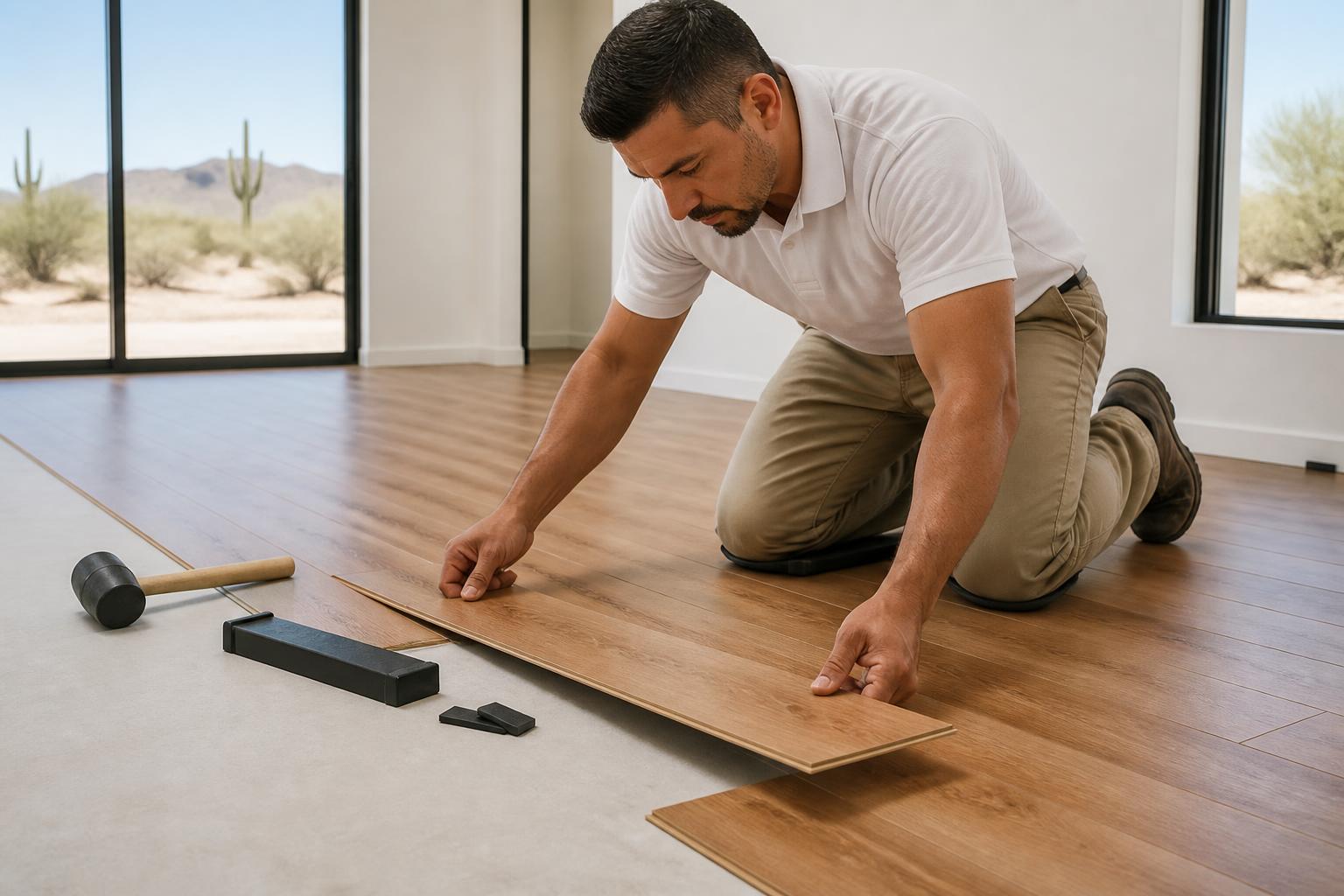
Laminate vs LVP at a Glance
Before we get into the details, here is the side-by-side. Read this once, then we will break each row down for Arizona conditions specifically.
| Feature | Laminate | LVP |
|---|---|---|
| Core material | High-density fiberboard with photographic wood-look layer | 100% PVC/vinyl with printed wear layer |
| Water resistance | Water-resistant; not waterproof | Fully waterproof |
| Scratch resistance | Excellent — typically AC4/AC5 wear layer | Good; softer surface can dent |
| Feel underfoot | Firm, more like real wood | Slightly softer, warmer |
| Look | Most realistic wood look in this category | Wood and stone looks, very versatile |
| Lifespan in AZ | 15–25 years installed properly | 20–30 years installed properly |
| Best for | Bedrooms, living rooms, hallways, offices | Kitchens, bathrooms, laundry, mudrooms |
Room-by-Room: Which Floor Goes Where
Most West Valley homes mix wet zones, sun-blasted rooms, and quiet bedrooms under one roof. Here’s a quick read on which product to spec where.
| Room | Better Pick | Why |
|---|---|---|
| Kitchen | LVP | 100% waterproof handles dishwasher leaks and everyday spills. |
| Full bath | LVP | Standing water and humidity rule out laminate. |
| Powder room | LVP | Splash exposure favors a waterproof core. |
| Laundry room | LVP | Appliance leaks are a question of when, not if. |
| Bedrooms | Laminate | Quieter underfoot, harder wear surface, lower moisture risk. |
| Living/family room | Either | Choose by sunlight exposure and pet traffic. |
| Hallways | Laminate (AC4+) | Abrasion resistance wins in high-traffic lanes. |
| Home office | Laminate | Chair-caster durability with an AC rating of 4 or higher. |
| Arizona room / enclosed patio | LVP | Temperature swings and occasional moisture demand a dimensionally stable plank. |
| Entry / mudroom | LVP | Grit, monsoon water, and dog paws all favor LVP. |
Why Choose Laminate for Your Arizona Home
Modern laminate is not the warped, hollow-sounding product your parents put in their kitchen in 1998. Today’s high-end laminate uses a much denser core, a tighter click-lock system, and a photographic wear layer that genuinely looks like real white oak, hickory, or walnut.
Laminate is the better pick when:
- You want the most realistic wood look for the money — the embossed textures on AC4/AC5 laminate beat most LVP in the same category.
- Scratch resistance is the top priority. Big dogs, kids, dining chairs, dragged furniture — laminate’s aluminum-oxide wear layer is one of the toughest surfaces in residential flooring.
- You are installing in bedrooms, living rooms, dining rooms, hallways, home offices, or stairs.
- You want a firm, solid-wood feel underfoot rather than the slightly softer feel of vinyl.
- You want a step above the bargain-bin tier without jumping into premium hardwood.
“Laminate usually wins in dry living spaces where homeowners want the sharpest wood look and the strongest scratch resistance for the money.” — West Valley Flooring Installation
Where LVP Wins
LVP’s big advantage is one word: waterproof. The whole plank is vinyl, so a spilled glass of water, a leaky dishwasher, or a toddler’s bath-time flood does not damage it.
LVP is the better pick when:
- You are flooring a kitchen, bathroom, laundry room, mudroom, or anywhere water lives.
- You have a slab with minor unevenness — LVP is more forgiving than laminate.
- You want a softer, warmer feel underfoot, especially for standing in a kitchen.
- You are doing the whole house in one product and want one floor that handles every room.
- You want a stone or tile look — LVP nails those textures better than laminate.
How They Actually Perform in Arizona
Most online comparison articles are written for the entire country. Arizona is its own beast — 110°F slabs in July, bone-dry winters, monsoon humidity swings, and abrasive desert dust tracked in on every shoe. Here is what we actually see in West Valley homes.
Heat and AC Cycling
Concrete slabs in the West Valley can hit 90–95°F in summer even with the AC running. Both laminate and LVP handle this, but LVP expands and contracts more with temperature swings, which is why every quality LVP install needs a proper expansion gap around the perimeter. Cut corners on that gap and you can get buckling.
Dry Winters and Monsoon Humidity
Phoenix-area humidity can swing from under 10% to over 70% in a single month. Laminate’s fiberboard core reacts more to humidity than LVP’s vinyl core, so on a laminate install, the planks should acclimate in the home for 48–72 hours before installation. Skip that step and seams can lift months later.
Pets, Sand, and Abrasion
Desert landscaping plus dogs equals fine, gritty sand tracked across the floor every day. That sand is rougher on a soft surface than on a hard one. This is where laminate’s harder wear layer pulls ahead — a quality AC4 laminate will show wear-through years later than a same-priced LVP in the same household.
Pool Homes and Water Exposure
If you have a pool, the path from the back door to the bathroom is going to get wet often. That is one of the most common reasons we recommend LVP in West Valley homes. It forgives wet feet, pool towels, and pool toys better than laminate.
Simple rule: Choose laminate for dry living spaces where scratch resistance and realistic wood visuals matter most. Choose LVP for wet rooms, pool paths, kitchens, laundry rooms, and whole-home waterproof convenience.
What Drives Installation Scope in the West Valley
Two laminate or LVP jobs in the same neighborhood can be very different installs. Here is what actually moves the scope — and the timeline — on West Valley homes in Surprise, Peoria, Goodyear, Buckeye, Avondale, Litchfield Park, Sun City, Verrado, and Glendale.
- Existing flooring removal: Ripping out old tile is the single biggest variable. Dustless tile removal helps keep your house from being coated in silica dust and is far cleaner than the old jackhammer-and-tarp method.
- Subfloor leveling: Older West Valley slabs are rarely flat. Click-lock floors above a 3/16" dip per 10 ft can start to flex and click apart, so proper leveling matters before any planks go down.
- Plank thickness and wear rating: 12mm AC4 laminate is a step up from 8mm AC3. LVP has a similar tier system based on wear-layer thickness, such as 12 mil, 20 mil, or 28 mil.
- Stairs, transitions, and trim: Stair nosing, T-molding, reducers, baseboards, and shoe molding are their own scope item. Plan for them separately from the field flooring.
- Furniture moving: Some installers include it, and some charge by the room. Always confirm before you compare quotes.
- Acclimation and moisture testing: Skipping the 48–72 hour acclimation or the slab moisture reading is how you end up with lifted seams six months in.
What Installation Actually Looks Like
Most West Valley laminate and LVP jobs run 1–3 days from start to walk-on.
View Typical Installation Timeline
| Project Stage | What Happens |
|---|---|
| Day 0 | Material is delivered and acclimated in the home for 48–72 hours when needed. |
| Day 1 | Existing flooring is removed, the slab is prepped and leveled, and the area is swept clean. |
| Day 2 | Underlayment is installed where needed, and planks are clicked together with proper expansion gaps. |
| Day 3 | Baseboards, shoe molding, transitions, and final cleanup are completed. |
Our crews are CFI-certified, which is the actual industry credential — not just “we have done this a long time.” That matters most on the things you cannot see after the floor is down: expansion gaps, subfloor prep, moisture testing, and seam alignment.
Still Not Sure Which One Is Right for Your House?
We do this comparison in person, for free, in every house we walk into. We bring samples of both products, look at your actual rooms, your actual lifestyle, your pets, your slab condition, and tell you straight: laminate here, LVP there.
Sometimes the answer is one product for the whole house. Sometimes it is laminate in the bedrooms and LVP in the wet rooms. There is no one-size-fits-all answer, and any contractor who gives you one without seeing the house is guessing.
You can learn more about our laminate flooring installation and vinyl plank flooring installation options.
Compare Laminate and LVP in Your Home
West Valley Flooring Installation provides professional laminate flooring installation, vinyl plank flooring installation, dustless tile removal, and full flooring services across the West Valley.
Request a Free EstimateWhat to Ask Your Installer Before You Sign
The plank you pick matters, but how it’s installed matters just as much — especially over Arizona slab. Run through this list with any contractor before you put money down.
- Will you moisture-test the slab before install, and what reading is acceptable?
- How long will the flooring acclimate inside my home before install begins?
- How will you handle subfloor leveling, and what flatness tolerance do you work to?
- What underlayment are you using, and is it appropriate for slab-on-grade in Arizona?
- How will transitions between rooms and to existing flooring be handled?
- How will you contain dust and debris during tear-out?
- What’s the plan for baseboards and shoe molding — reuse, reinstall, or replace?
- Who handles warranty claims if a plank fails — you or the manufacturer?
- What’s the expected timeline from tear-out to walk-on-ready?
- Will you provide written documentation of the install, including product batch, underlayment used, and moisture readings?
Frequently Asked Questions
Is laminate or LVP the more budget-friendly choice?
Laminate is generally the more budget-friendly of the two for the equivalent quality tier, mostly because LVP’s waterproof construction adds material cost. That said, the gap narrows at the high end — premium 12mm laminate and mid-tier LVP often land in the same range. Pricing in the West Valley changes with mil, thickness, removal scope, and subfloor condition, so we quote every job after we have walked your house.
Which lasts longer in Arizona, laminate or LVP?
LVP edges out laminate on raw lifespan, mostly because it is immune to water and humidity swings. But laminate wins on scratch resistance, so if your wear pattern is dogs and dragged furniture rather than spilled liquid, laminate often looks newer for longer.
Which is more scratch-resistant?
Laminate, by a clear margin. A quality AC4 or AC5 laminate has an aluminum-oxide wear layer that is one of the hardest surfaces in residential flooring. LVP’s vinyl wear layer is softer and can dent under heavy point loads.
Can I install laminate in a kitchen?
You can, but we usually recommend against it. A dishwasher leak or dropped ice-maker line can soak the seams and swell the fiberboard core within hours. In West Valley kitchens, we almost always recommend LVP flooring instead.
Can I install laminate or LVP over existing tile?
Sometimes. If the tile is flat, well-bonded, and the grout lines are not too deep, it may be possible. If the tile has cracks, hollow spots, or major lippage, we recommend removing it with our dustless tile removal service first.
Do you serve my city?
Yes. West Valley Flooring Installation serves Surprise, Peoria, Goodyear, Buckeye, Avondale, Litchfield Park, Sun City, Sun City West, Verrado, Waddell, El Mirage, Glendale, and other West Valley service areas.
How long until I can walk on it?
Same day. Both laminate and LVP are walkable as soon as they are clicked together — no glue cure, no finish drying. Furniture goes back once baseboards, transitions, and final cleanup are complete.
West Valley Flooring Installation is a CFI-certified flooring company serving Surprise, Peoria, Goodyear, Buckeye, Avondale, Litchfield Park, Sun City, Verrado, and Glendale. We install laminate, luxury vinyl plank, tile, carpet, and hardwood, and we offer dustless tile removal to keep your home cleaner during the transition.
